
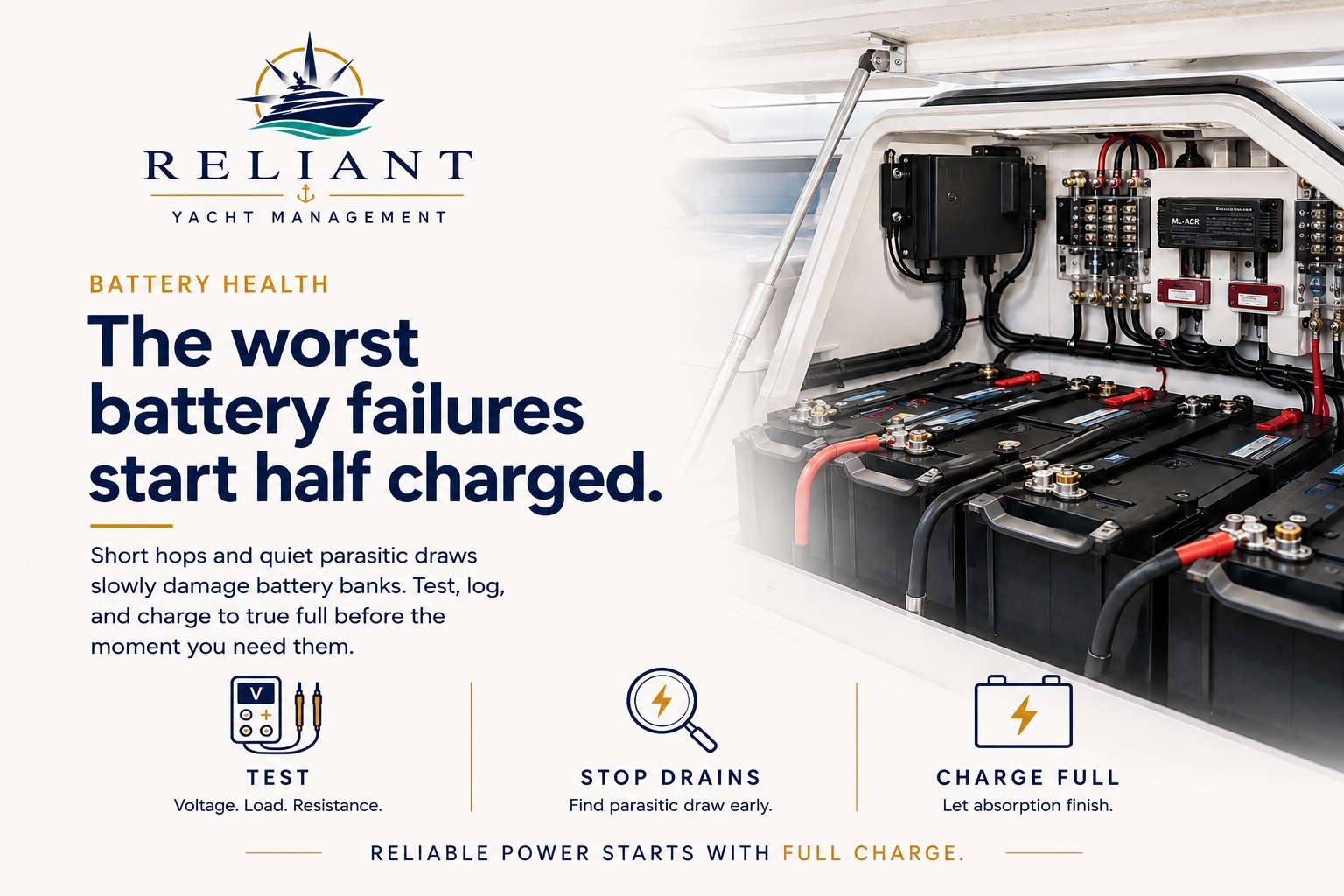
The Overlooked Reason Yacht Batteries Fail At The Worst Time
Most yacht owners assume batteries fail because they’re “old” or because they forgot to plug in. In reality, the most common reason batteries let you down at the worst possible moment is much simpler—and far more preventable:
No one is consistently testing, logging, and interpreting what the batteries are telling you over time.
Without trend data and proper load testing, a battery bank can look “fine” on a dockside voltage check, only to collapse the moment you need it underway, at anchor, or just before a storm.
For absentee owners and busy professionals, this silent deterioration is easy to miss. The good news: with the right checks and documentation, you can dramatically reduce surprise failures and extend battery life.
Why Batteries Fail When Everything “Looked Fine”
Most yachts don’t suffer from a complete absence of maintenance. They suffer from incomplete information.
Common patterns we see:
- A quick voltage reading at the dock shows 12.7V and “charged”
- The charger is on, shore power is connected, and indicator lights look normal
- No one has tested the batteries under real load or compared readings over time
On the surface, everything appears healthy. But beneath that:
- Plates may be sulfated from chronic partial charging
- A weak cell may be dragging down an entire bank
- House loads and parasitic draws may be slowly discharging a battery at the dock
- A failing charger or misconfigured setting may be under- or over-charging
Voltage at rest is a snapshot. Battery health is a story over time. When that story isn’t being recorded, failures show up as “sudden”—even though they’ve been developing for months.
The Three Pillars Of Smart Battery Care: Test, Log, Interpret
Extending battery life and avoiding surprise failures comes down to three disciplines:
- Regular testing
- Consistent logging
- Thoughtful interpretation
1. How To Test Yacht Batteries Properly
A practical testing routine doesn’t require lab equipment—just a methodical approach.
Key tests include:
-
Open-circuit voltage checks
- Measure battery voltage after it’s been at rest (no charging, no significant load) for a few hours.
- Compare to manufacturer’s state-of-charge chart (e.g., 12.7V ≈ 100%, 12.2V ≈ ~50% for many 12V lead-acid batteries).
-
Under-load testing
- Turn on typical house loads (lights, electronics, pumps) or use a dedicated load tester.
- Watch how quickly voltage drops under load and how it recovers when the load is removed.
- Abnormal voltage sag or slow recovery often reveals declining capacity before complete failure.
-
Individual battery checks in a bank
- For multi-battery banks, check each unit individually when possible.
- Look for outliers—one weak battery can compromise an otherwise good bank.
-
Charging system verification
- Confirm charger and alternator output voltages are appropriate for your battery type (flooded, AGM, gel, lithium).
- Inspect connections, cable condition, and breaker/fuse protection.
For seasonal and absentee owners, this type of testing should be done on a schedule, not only when something feels off.
2. Why Logging Matters More Than Any Single Test
A single good test doesn’t guarantee a healthy battery bank. Trends do.
Consistent logging allows you to see:
- Gradual loss of capacity over months
- Slower recovery after load as batteries age
- Deviations in performance between individual batteries
- Early warning signs of charger issues or parasitic loads
At minimum, your battery log should record:
- Date and time
- Battery bank (start, house, thruster, generator, etc.)
- Voltage at rest
- Voltage under defined load (and duration of the load)
- Charger status and shore power status
- Any observed issues (slow cranking, dim lights, nuisance alarms)
In Reliant’s Vessel Intelligence platform, this information becomes part of the yacht’s operational record. That makes it easy to compare:
- “How did this house bank behave last year before hurricane season?”
- “Is this the first time we’ve seen this much voltage sag?”
- “Did performance change after the charger was replaced?”
Without documentation, it’s guesswork. With documentation, it’s a clear pattern—and better decisions.
3. Interpreting Data To Prevent Problems
Data only helps if someone knowledgeable looks at it and asks:
- Is this battery aging normally, or failing early?
- Is the charger profile correct for this battery chemistry?
- Are the owner’s usage patterns accelerating wear?
For example:
- If resting voltage is still “normal” but time-to-recharge after a typical day aboard keeps increasing, the bank may be losing capacity.
- If a single battery in a bank consistently tests lower than its mates, preemptive replacement may avoid a mid-season failure.
- If voltage at rest is fine, but voltage collapses under modest load, the battery may have lost much of its usable capacity even though it appears “charged.”
Professional oversight means these patterns are recognized early, documented clearly, and translated into straightforward recommendations for the owner.
Practical Ways To Extend Your Yacht’s Battery Life
Once you’re testing and logging consistently, several practical steps can significantly extend battery life:
-
Avoid chronic partial charging
- Regularly allow batteries to reach a true full charge, not just “good enough for now.”
- Ensure your charger is capable of properly completing the full charge cycle.
-
Respect depth-of-discharge limits
- Repeatedly draining lead-acid batteries below ~50% state of charge shortens their life.
- Configure low-voltage cutoffs and monitor usage to stay within recommended limits.
-
Match charging systems to battery type
- AGM, gel, flooded, and lithium batteries each require specific charge profiles.
- Incorrect settings can quietly damage batteries over time.
-
Control parasitic loads at the dock
- Identify always-on consumers (monitors, lighting, pumps) that slowly discharge batteries.
- Use smart breakers, switches, or load management to reduce unnecessary draw.
-
Keep connections clean and secure
- Corrosion and loose terminals create resistance, heat, and unreliable performance.
- Regular inspection and cleaning are simple, high-value maintenance tasks.
-
Replace batteries as a system when appropriate
- In many banks, mixing old and new batteries is false economy.
- Planned, documented replacement avoids emergency changes under pressure.
Why Professional Oversight Matters For Absentee Owners
For owners who are out of state, traveling frequently, or simply focused on other priorities, battery health often becomes “out of sight, out of mind” until a trip is delayed or a storm is approaching.
A professional owner’s representative can:
- Establish and follow a battery testing schedule
- Log every inspection in a centralized, accessible platform
- Track performance trends and recommend changes before failure
- Verify charger settings after service or upgrades
- Confirm that work was completed correctly—not just “billed”
At Reliant Yacht Management, every battery check, charger adjustment, and replacement recommendation is documented with photos, readings, and context inside the Reliant Vessel Intelligence platform. Owners see not just what was done, but why—and how it affects readiness.
Professional Care Aboard. Complete Visibility Ashore.
Battery failures rarely come out of nowhere. They come from slow, silent changes no one was tracking.
If you’d like consistent testing, detailed logging, and proactive oversight of your yacht’s batteries—and every other critical system—Reliant Yacht Management can help.
Contact us to schedule an initial vessel review and learn how our professional care and Vessel Intelligence platform can keep your yacht ready whenever you are.